|
1-800-626-6536
|
|
| "Therefore, write down this song and teach it to the children of Israel . . ." --Deut. 31:19 |
|
|
| Glossary of Terms |
|
Ari - 16th century Kabbalist - Rabbi Isaac Luria. In our case it refers to the style of writing instituted by him. This style is most commonly used by Chassidim and others who adhere to the Kabbalah.
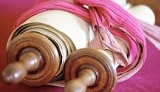
Atzei Chaim - Literally “Trees of Life”. In this case it refers to the wooden poles with their handles which the Torah scroll must be mounted onto.
Beis Yosef - 16th century author of the “Shulchan Aruch” or “Code of Jewish Law” - Rabbi Joseph Karo. In our case it refers to the style of writing codified by him. This is the standard style used by most Ashkenazi Jews.
Gartel - Yiddish for belt. This is the belt that is tied around Ashkenazi Torah scrolls to keep it closed in the Mantel.
Keter - Hebrew for “crown“. The ornamental crown which is placed on top of Ashkenazi Torah scrolls.
Klaf - Hebrew for parchment. Klaf for Torah scrolls must be made from the skin of a Kosher animal. The entire process must be preformed by an observant Jew for the sake of the Mitzvah of the Torah scroll.
Mantel - Yiddish word for the decorative fabric cover which covers Ashkenazi Torah scrolls.
Mehudar - Hebrew for beautiful. Generally used to refer to a Mitzvah being performed in the best way. A Mehudar Torah scroll means a Torah scroll made in a way which not only meets the minimum requirements of Jewish Law, but also surpasses them and is aesthetically beautiful.
Sefardi - Literally means Spanish in Hebrew. In our case it refers to the style of writing used by Jews of Spanish and Middle Eastern descent.
Sefer Torah (Hebrew: ספר תורה, plural ספרי תורה, Sifrei Torah; "Book(s) of Torah" or "Torah Scroll(s)" ) is a specially hand-written copy of the Torah or Pentateuch, which is the holiest book within Judaism (originally called Torath Moshe) and venerated by Jews. It must meet extremely strict standards of production. In its completed state it is stored in the holiest spot within a synagogue called the Aron Kodesh ("Holy Ark", usually called "the Ark", a reference to the Ark of the Covenant), usually an ornate curtained-off cabinet or section of the synagogue, which is usually built along the wall that most closely faces Jerusalem, the direction faced by Jews when engaged in prayer.
Shlil - Refers to a type of Klaf made from skin of an unborn animal found in its mothers womb at the time of slaughter. This type of Klaf is considered the best type because of its superior texture as well as for Kabbalistic and other reasons.
Sofer STaM - STaM is an acronym for three of the sacred Jewish scribal items--Sifrei Torah (scrolls containing the first five books of the Bible), Tefillin (phylactaries) and mezuzot--a parchment on which portions of the Shema Yisrael prayer are written, and which Jews are commanded to place on their doorposts. STaM must be written on parchment in black ink by a Torah-observant man. The writing must be legible to a child just learning to read Hebrew and must conform to standards described in the Tor, a book of Jewish law. Within those criteria, there is room for variation in style and artistic impact. |
|
|
|
Home | About Us | New Torahs | Used Torahs | Torah Restoration | Torah Appraisals | Torah Accessories | Glossary of Terms | Photos | Contact Us
Alltorahscrolls.com General Information - Phone: 800-626-6536 | Local: 773-262-1700 | Fax: 773-262-1930
Copyright © 2007 Rosenblum's World of Judaica, Inc. and Alltorahscrolls.com. All rights reserved.
|